
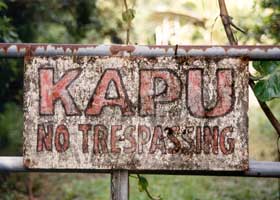
Most famous are the restrictions on contact with chiefs (kings), but these also apply to all people with known spiritual power. It was Kapu enter a chieftain personal sphere to get in touch with his hair or fingernail clippings, to look directly at him and be in sight of him with a head taller than his. Wearing red and yellow feathers (a sign of royalty) was Kapu, unless you were of the highest rank. Places Kapu often symbolized by two crossed staffs, each with a white ball on top.

"Kapu" restrictions were also used to regulate the Hawaiian fishing in order to preserve the long-term viability of marine life in 1700 and the 1800s. Some fish and / or designated areas was banned (or Kapu) at times when over-fishing can harm the environment. This corresponds to the modern regulation of supervision and regulation of fishing and hunting through licensing, but was well before "modern" era and showed great insight into sustainable living.
The Kapu system was used in Hawaii until 1819, when King Kamehameha II, which deals with his mother and his father Keopuolani Queen Ka'ahumanu, abolished it by the symbolic act of sharing a meal with forbidden foods with the women in his court.

Hawaii's history is rich with these practices for centuries. Many natives still use the practice of "Kapu", forbidding access to many of those deemed not ready. Other take it in a much lighter sense, much like the English "Keep Out" sign, or the "Do Not Disturb".
So next time you go to Hawaii, and don't want anyone to bother you, just hang "Kapu" on your door, and most will get the hint!
