Polynesia is home to a dynamic island culture. Perhaps best known for a culture incorporating tiki gods, Polynesia is also known for great food! If you're thinking of hosting a luau or a tropical party, one of the most important steps of your party planning process is to seek out Polynesian recipes. While many of these mirror similar dishes found in Hawaiian cuisine, others are unique to the native Polynesians, or blend a wide array of culinary traditions, including those found in Hawaii, Asia, and even the mainland U.S.
When most people think of Polynesian food, they think of dishes featuring chicken, poi, and/or pineapple. These are certainly a few staple ingredients found at most Polynesian meals. Traditionally the Polynesian diet also features taro root and sweet potatoes, as well as rice and beans. Hawaiian baked beans, one staple dish, often comprise a large part of both Hawaiian and Polynesian fare.
For sweet recipes, the Polynesian diet often incorporates banana and coconut, like many other tropical islands. Both of these crops are traditionally grown on the Polynesian islands, and using them as ingredients for your luau menu will certainly provide an added flavor of authenticity.
Of all of these traditional Polynesian ingredients, taro root and poi are the two that are typically unfamiliar to American audiences. Taro root is the root of a tuber plant, related to yams and potatoes. Considered a staple in many cultures of Africa, Oceania, and Asia, it has a texture similar to that of a sweet potato, with a flavor like that of a potato. In the U.S., it can be found at most supermarkets carrying a large selection of Asian foods. Poi is made from the taro plant, which is cooked and then mashed into a pudding-like consistency.
Although these two ingredients are not typically found in dishes created in the mainland U.S., most of the other ingredients needed for Polynesian recipes can easily be found in any grocery store. Who says that you must be in Hawaii to experience a luau, or Polynesia to experience a delicious Polynesian feast? You can cook easy Polynesian-inspired dishes in your own home, using ingredients you're already familiar with.
For the most part, Polynesian food is traditionally cooked in an earthen oven. For your own Polynesian party, this means plenty of baked dishes, though of course you can use your regular oven as an alternative to the traditional earthen oven.
Often, the key to creating the perfect menu for a luau or tiki-themed party lies in authentic Polynesian fare that's familiar enough to please mainland palates. This was certainly true in the tiki lounges that sprang up in the 1930s, tiki bars during the tiki craze of the 50's and 60's, and in today's restaurants around the world that feature Polynesian-inspired menus.
For the main course, look towards sweet and sour sauce for something that's a bit familiar to most mainland taste buds, yet also quite exotic and tropical. Most people are familiar with this sauce from Chinese restaurants. Recipes for Polynesian sweet and sour sauce typically require sugar and white vinegar, and are used to coat pork, chicken, or shrimp. As an alternative to sweet and sour, use soy sauce to coat the meat. Fried rice is another great dish that is certainly Polynesian, yet also familiar to those on the mainland.

Showing posts with label feast. Show all posts
Showing posts with label feast. Show all posts
April 21, 2011

April 17, 2011
Kona Coffee - More than Just "Gourmet"
Hawaiian peaberry coffee, grown in Kona, Hawaii, is known for its smooth, full-bodied flavor, unforgettable taste and rich aroma. The main secret of such tasteful and different beans is the perfect blend of all the six elements comprising of rich soil, proper elevation, cloud cover, sunshine, rain and a moderate slope helping in the drainage of the roots provided by the Hawaiian islands, have ensured an ideal environment to produce some of the richest product in the world.
Kona peaberry coffee is an estate coffee. Rare and most exclusive, these beans comprise only 5% of total crop. Coffee producers note that the peaberry cherries are usually found at the ends of the tree branches. Some farmers believe that these cherries with a single bean are formed when the wind blows half of the white coffee flower away before it forms the beginnings of the cherry. These rare beans are hand-picked by 600 working farms in Kona district of Hawaii Islands. Kona coffee producers use the special wet-method of processing and sun-drying to make sure they get a certified gourmet product.
As a result, the price and demand for Hawaiian peaberry coffee is higher than other types of this gourmet drink thanks to its rich, smooth flavor and low acid content.
This grade was awarded even a top 10 ranking as one of the best-quality coffee by Food and Wine Magazine in March, 2006.
You may choose either freshly roasted beans or ground coffee. Many coffee lovers prefer buying beans to grind them at home themselves.
Why are peaberry beans more expensive than other grades?
This grade is rare and therefore more expensive than other types, but really worth a modest added cost for the coffee lover. And even more valuable than you might think! Why? - Because these delicate beans with rich aroma are distinguished from commercial blends with the tremendous care taken at every step of the cultivation and gathering process. Experts around the world know this very well.
Perhaps that's why worldwide coffee drinking societies prefer drinking Hawaiian peaberry beans as the royalty of all coffees. All the above mentioned excellent features have made this highest grade Kona coffee one of the two most highly-valued gourmet beverages in the world.
It is a unique product of Hawaii, and like so many things about Hawaii, cannot be found anywhere else in the world.
Kona peaberry coffee is an estate coffee. Rare and most exclusive, these beans comprise only 5% of total crop. Coffee producers note that the peaberry cherries are usually found at the ends of the tree branches. Some farmers believe that these cherries with a single bean are formed when the wind blows half of the white coffee flower away before it forms the beginnings of the cherry. These rare beans are hand-picked by 600 working farms in Kona district of Hawaii Islands. Kona coffee producers use the special wet-method of processing and sun-drying to make sure they get a certified gourmet product.
As a result, the price and demand for Hawaiian peaberry coffee is higher than other types of this gourmet drink thanks to its rich, smooth flavor and low acid content.
This grade was awarded even a top 10 ranking as one of the best-quality coffee by Food and Wine Magazine in March, 2006.
You may choose either freshly roasted beans or ground coffee. Many coffee lovers prefer buying beans to grind them at home themselves.
Why are peaberry beans more expensive than other grades?
This grade is rare and therefore more expensive than other types, but really worth a modest added cost for the coffee lover. And even more valuable than you might think! Why? - Because these delicate beans with rich aroma are distinguished from commercial blends with the tremendous care taken at every step of the cultivation and gathering process. Experts around the world know this very well.
Perhaps that's why worldwide coffee drinking societies prefer drinking Hawaiian peaberry beans as the royalty of all coffees. All the above mentioned excellent features have made this highest grade Kona coffee one of the two most highly-valued gourmet beverages in the world.
It is a unique product of Hawaii, and like so many things about Hawaii, cannot be found anywhere else in the world.
February 13, 2011
Kapu - Royalty Above the Polynesians
Hawaii Kapu word is usually translated into English as "prohibited", but it also involves using "holy", "initiate" or "holy". In ancient Hawaii, Kapu refers to the old system of laws and regulations. An offense that was Kapu was often a corporal offense, but also often called a threat to spiritual power, or theft of mana. Kapus was strictly enforced. Breaking an even unintentionally often meant instant death. The concept is related to taboo and deed or taboo in other Polynesian cultures.

Most famous are the restrictions on contact with chiefs (kings), but these also apply to all people with known spiritual power. It was Kapu enter a chieftain personal sphere to get in touch with his hair or fingernail clippings, to look directly at him and be in sight of him with a head taller than his. Wearing red and yellow feathers (a sign of royalty) was Kapu, unless you were of the highest rank. Places Kapu often symbolized by two crossed staffs, each with a white ball on top.

The Kapu system also governed contact between men and women. In particular, men and women could not eat meals together. Furthermore, certain foods such as pork, some types of bananas (which they resembled a phallus), and coconuts were Kapu women. As these examples suggest, the sense of the term in Polynesia carries connotations of sacredness as much as forbidden-ness. Probably the best way to translate it into English is "marked off" or ritually limited. The opposite of Kapu's "Noah" which means "common" or "Free".
"Kapu" restrictions were also used to regulate the Hawaiian fishing in order to preserve the long-term viability of marine life in 1700 and the 1800s. Some fish and / or designated areas was banned (or Kapu) at times when over-fishing can harm the environment. This corresponds to the modern regulation of supervision and regulation of fishing and hunting through licensing, but was well before "modern" era and showed great insight into sustainable living.
The Kapu system was used in Hawaii until 1819, when King Kamehameha II, which deals with his mother and his father Keopuolani Queen Ka'ahumanu, abolished it by the symbolic act of sharing a meal with forbidden foods with the women in his court.

Hawaii's history is rich with these practices for centuries. Many natives still use the practice of "Kapu", forbidding access to many of those deemed not ready. Other take it in a much lighter sense, much like the English "Keep Out" sign, or the "Do Not Disturb".
So next time you go to Hawaii, and don't want anyone to bother you, just hang "Kapu" on your door, and most will get the hint!
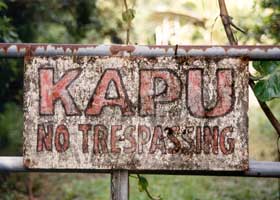
Most famous are the restrictions on contact with chiefs (kings), but these also apply to all people with known spiritual power. It was Kapu enter a chieftain personal sphere to get in touch with his hair or fingernail clippings, to look directly at him and be in sight of him with a head taller than his. Wearing red and yellow feathers (a sign of royalty) was Kapu, unless you were of the highest rank. Places Kapu often symbolized by two crossed staffs, each with a white ball on top.

"Kapu" restrictions were also used to regulate the Hawaiian fishing in order to preserve the long-term viability of marine life in 1700 and the 1800s. Some fish and / or designated areas was banned (or Kapu) at times when over-fishing can harm the environment. This corresponds to the modern regulation of supervision and regulation of fishing and hunting through licensing, but was well before "modern" era and showed great insight into sustainable living.
The Kapu system was used in Hawaii until 1819, when King Kamehameha II, which deals with his mother and his father Keopuolani Queen Ka'ahumanu, abolished it by the symbolic act of sharing a meal with forbidden foods with the women in his court.

Hawaii's history is rich with these practices for centuries. Many natives still use the practice of "Kapu", forbidding access to many of those deemed not ready. Other take it in a much lighter sense, much like the English "Keep Out" sign, or the "Do Not Disturb".
So next time you go to Hawaii, and don't want anyone to bother you, just hang "Kapu" on your door, and most will get the hint!
Subscribe to:
Posts (Atom)